Peace talks in Berlin: solutions sought without illusions and without backroom concessions at Ukraine’s expense
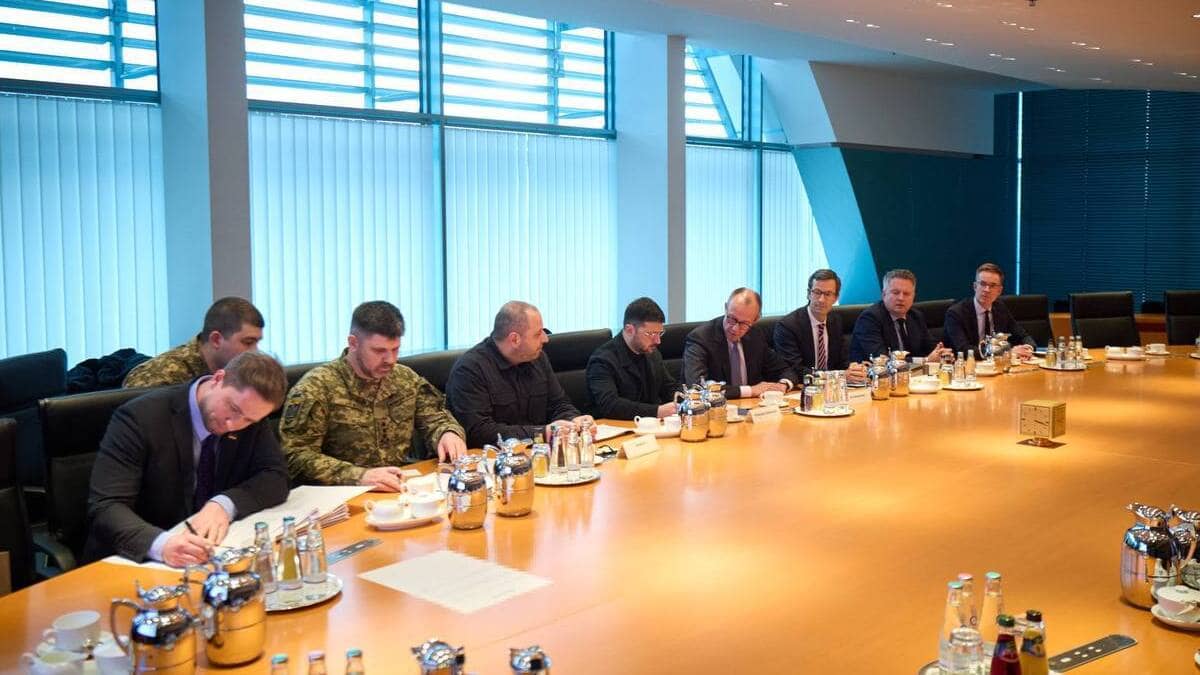
Peace talks in Berlin between Ukraine and the United States are continuing almost around the clock, addressing the most sensitive aspects of ending the war, including territorial issues and security guarantees. The Ukrainian side stresses that no decisions will be made behind Ukraine’s back and no concessions will be accepted without justice.
The Berlin talks have entered an almost around-the-clock mode. For the second consecutive day, the Ukrainian delegation led by President Volodymyr Zelenskyy has been holding intensive discussions with the U.S. side on the terms of a potential peace agreement. The stakes are high: this is not merely about a ceasefire, but about a format for ending the war that will not break Ukraine from within.
The Office of the President told Suspilne about the progress of the meetings in Berlin, while key signals were voiced publicly during a joint press conference by Zelenskyy and German Chancellor Friedrich Merz.
What is being discussed in Berlin
The President confirmed that talks with the American delegation are continuing with minimal pauses, with the goal of finding a solution that respects the interests of the Ukrainian people. At the same time, Zelenskyy acknowledged that not all topics are equally straightforward. The most difficult block concerns territorial issues.
The Ukrainian side insists on an honest dialogue and a clear articulation of positions without illusions, even if those positions do not align. This is precisely what the President did in Berlin—personally conveying Ukraine’s stance to its partners.
“Of course, not all issues are simple. There are difficult matters, particularly regarding territories. Naturally, all these questions are being raised. And it is important that we all work to ensure such issues are absolutely fair. There has been sufficient dialogue on territorial matters. Frankly, it seems to me that for now we have different positions. But I believe our colleagues have heard my personal position,” Volodymyr Zelenskyy said.
The President stressed that despite differences, all parties are demonstrating readiness to work productively—for solutions that bring about a real end to the war rather than creating new, frozen conflicts.
“Ukraine is ready to continue working with the highest possible quality—constructively and honestly—so that the final agreement is strong. There will be further meetings today; we are coordinating in detail with the Chancellor, with Friedrich,” the head of state added.
Progress and cautions
National Security and Defense Council Secretary Rustem Umerov, a member of the delegation, described the talks as constructive and productive. According to him, real progress has been achieved over the past two days, and the negotiating teams are working without disruptions or conflict.
Umerov specifically urged the public not to give in to information noise and anonymous “leaks” that have been actively circulating in the media amid the Berlin meetings. He said the American team—particularly Special Envoy Steve Witkoff and Jared Kushner—is working extremely constructively with Ukraine.
He also publicly thanked U.S. President Donald Trump and his team for their efforts aimed at finding a long-term peace solution.
A separate signal: weapons and the economy
Against the backdrop of complex war-related negotiations, Zelenskyy made another important—no less strategic—announcement in Berlin. According to him, the first office of a new Ukrainian export project focused on arms exports will open in the German capital.
The initiative envisions a dedicated platform designed to combine Ukraine’s technological developments with Germany’s economic capacity—primarily in the field of advanced drones.
The President emphasized that Ukrainian technologies developed during the war can strengthen not only Ukraine’s defense capability but that of Europe as a whole. This is why the format of intergovernmental consultations between Kyiv and Berlin is also being revived, with a focus on industry, energy, and defense projects.
Who is at the negotiating table
The Ukrainian delegation in Berlin is led by Volodymyr Zelenskyy. Alongside him are NSDC Secretary Rustem Umerov, First Deputy Foreign Minister Serhii Kyslytsia, Adviser to the Head of the Presidential Office Oleksandr Bevz, and Chief of the General Staff Andrii Hnatov.
The U.S. side is represented by Special Envoy Steven Witkoff, adviser and son-in-law of Donald Trump Jared Kushner, as well as Supreme Allied Commander Europe (SACEUR) General Alexus Grynkewich.
The talks in Berlin are ongoing. And it is here—between complex peace formulas and the harsh reality of the front—that Ukraine is trying to secure the essential point: that the end of this war does not become the beginning of another.